©

Crete Randonnee Camille Auriol

Setting off on an adventure

 in complete safety

Safety and assistance

Ajouter aux favoris

To explore RivierALP is to choose adventure. Living it with peace of mind means preparing for it.
Between the Alps and the Mediterranean, our itineraries take you through unspoilt areas where safety is an integral part of the journey. Being well informed and adopting the right reflexes means you can make the most of the experience, while respecting nature and those who share it.

Before you set off: think ahead

At RivierALP, safety starts before you put on your shoes or get on your bike. Take 5 minutes for a calmer adventure.

  • Plan your route: distance, gradient, duration, possible exit points.
  • Check trail access: roadworks, tricky sections, terrain conditions.
  • Adapt to your level: your fitness level for the day counts as much as your “usual” level.
  • Tell someone you know: place of departure, itinerary, estimated time of return.
  • Anticipate the unexpected: delays, weather, fatigue, low battery, puncture.
Find out about the weather

In the mountains, the weather can change quickly. On the coast, the heat can be surprising. These different types of weather can be dangerous for hikers, so it’s essential to :

  • Check the weather forecast before setting off and just before departure.
  • Keep an eye out for warnings (heat, thunderstorms, strong winds, heavy rain).

In the event of a thunderstorm or heavy rain, adopt the right reflexes to limit the risks:

  • Don’t take shelter under a tree, even an isolated one.
  • Avoid ridges, summits and exposed areas.
  • Do not carry any visible metal objects.
  • Switch off mobile phones and radios without attempting to use them.
  • Space yourself to limit the risks in the event of impact.
  • After heavy rain on dry ground, heavy run-off increases the risk of falling rocks. Proceed with caution.

How to use a GPX track

GPX tracks are files that describe a route. They can be used with a navigation application (e.g. Komoot) or a GPS.

  • Download the track before setting off (network sometimes limited in the mountains).
  • Activate the “position” display and keep a regular eye on your progress.
  • A track does not erase the reality of the terrain: pay attention to the markings and the conditions.
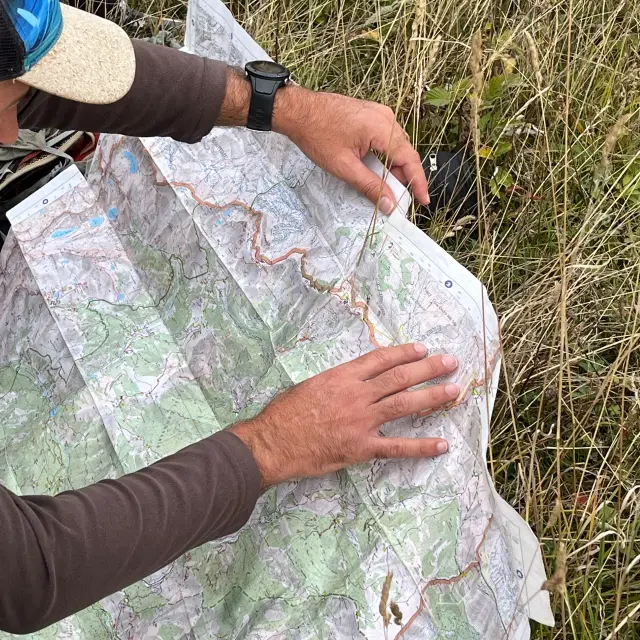
  • If in doubt, return to the last safe point and cross-check with the map.
  • Always have a plan B: an exit point, a nearby village, a self-assured U-turn.

Protection dogs: adopting the right reflexes

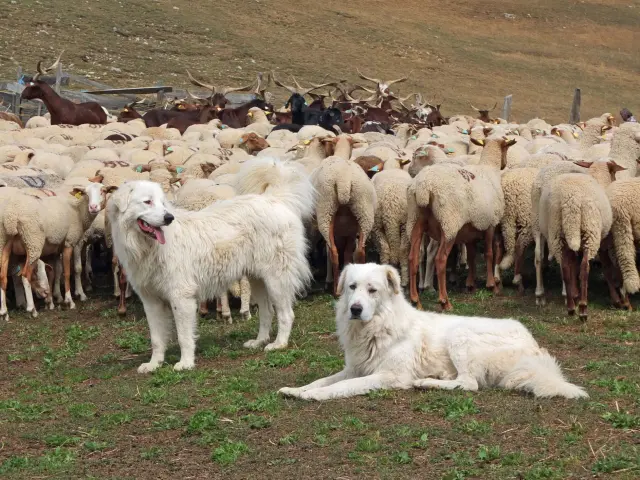
Patous are protection dogs, not attack dogs. They accompany herds to defend them against predators, particularly wolves. Their job is to keep an eye on the animals and make them feel safe. They can therefore be vigilant, even suspicious, of anyone outside the herd. They are essential to the balance of pastoral areas. So to facilitate their work and ensure your safety as a mountain biker or hiker, it’s important to adapt your behaviour to encourage the best possible cohabitation.

To prepare for your hike or mountain bike outing in complete peace of mind, visit our page dedicated to guard dogs and discover all the good habits to adopt.

Assistance & rescue Protect, alert, rescue

Support 

Don’t leave the person alone, and assess their condition

Security 

Move yourself and the group away from immediate danger

Temperature 

Cover up and reassure: the cold arrives quickly

Le 112 

Raise the alarm by contacting emergency services on 112

Visual signalling 

Visually signposting the victim’s location

At your disposal 

Remain available for rescuers

Contacting emergency services

112: European emergency number (works in France and Italy).

Give simple information:

  • Where: location, itinerary, altitude, environment.
  • Who: identity, telephone number
  • What: type of accident, number of victims, seriousness.
  • When: time of accident.
  • Weather: wind, visibility, precipitation.

In the event of helicopter rescue

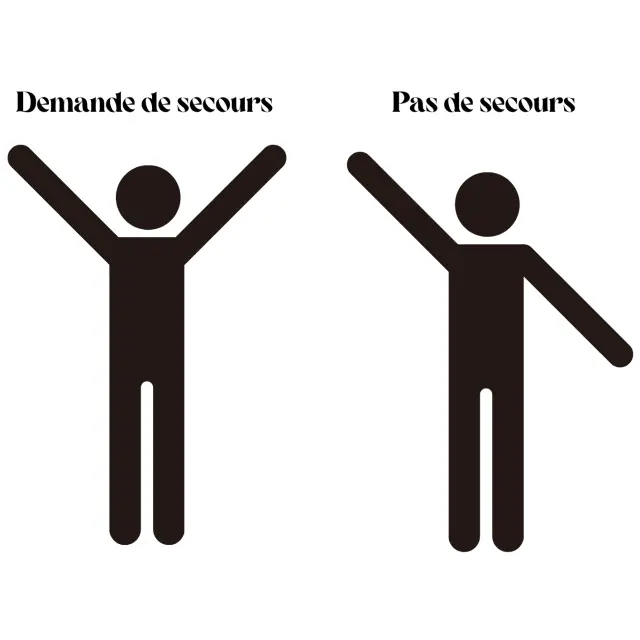
  • Signal your presence using conventional distress gestures.
  • Protect your eyes and those of the victim from dust or debris blown by the blades.
  • Never approach the aircraft without being expressly invited to do so by the crew.
  • Remain attentive when the rescuer descends and secure the area around you.

Responsible practices

RivierALP is a living place: hikers, cyclists/mountain bikers, locals, professionals, farmers… everyone shares the same paths.

To ensure that everyone gets on well together, that everyone is safe and that the mountains are preserved, it’s important to adopt a few simple gestures.

Hiking safety

Essential mountain equipment

  • Appropriate clothing: a breathable base layer, an insulating mid-layer such as a fleece, and an outer layer that is both waterproof and windproof.
  • Suitable footwear
  • Adapted walking stick
  • Bring 1.5 to 2 litres of water for a day’s outing. Look out for water access points on the stages and have a water purification system with filters (straws, filter bottles) or chlorine tablets.
  • Something to eat (even for a “short” outing)
  • Sun protection: glasses, cream, cap
  • Orientation equipment: map/compass/application/track
  • A small torch (useful if you’re running late)
  • First aid kit, which you can prepare following the recommendations of the French hiking federation.
  • Charged telephone + external battery
  • Whistle (simple and effective for signalling)
  • For bivouacs: a sleeping bag adapted to the temperature, a mattress, a tent and a stove.

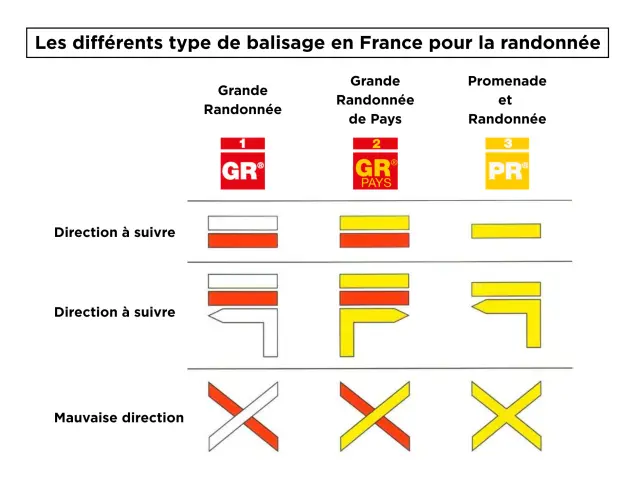
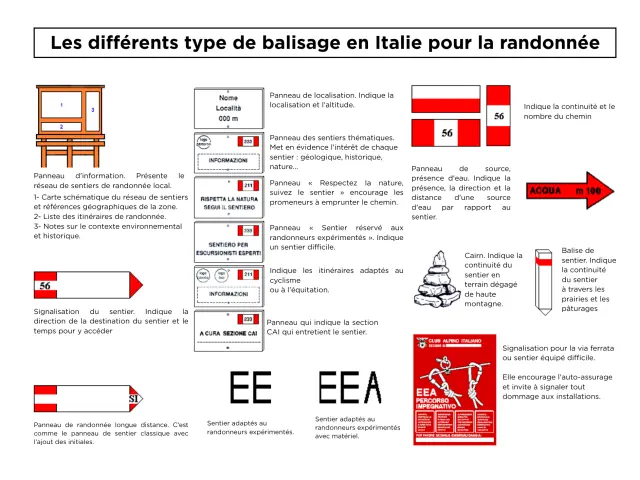
Reading the footpaths

As you make your way along the trail, you’ll find various signs to guide you.

You will find :

  • Signs specific to RivierALP
  • Official signs for France
  • As well as those for Italian territory.

BIKE & MTB safety

Checking your bike

For your own safety, check thecondition of your bike before every ride:

  • Brakes (front/rear), condition of pads
  • Tyre pressure and condition (wear, cuts)
  • Steering and tightening (wheels, stem, saddle)
  • Transmission (chain, gears)
  • EAB: battery level + appropriate assistance

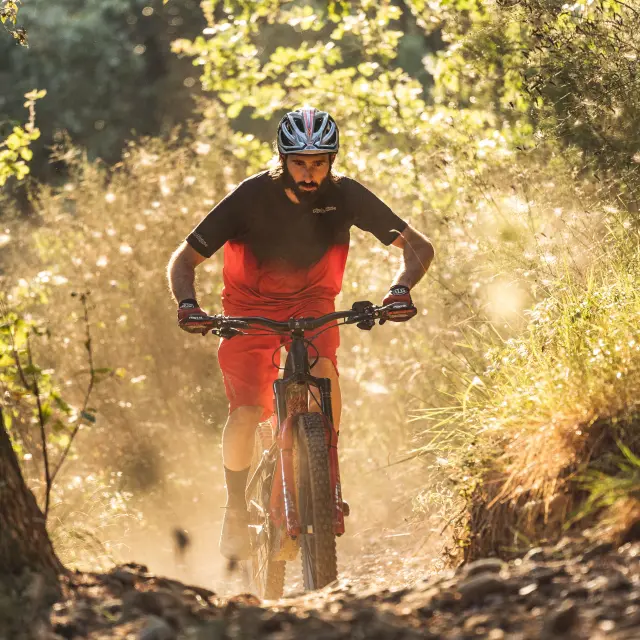
Be ready for anything on your mountain bike

When venturing out on your own on a RivierALP mountain bike, in addition to your hiking equipment, it’s essential to bring along the gear you need to deal with any unforeseen circumstances:

  • Bike pump
  • Spare inner tube
  • Repair kit (patches + glue)
  • Tyre levers
  • Multi-tool with chain drive
  • Quick link for chain
  • Serflex / cord (quick repairs)

    Specific protective equipment

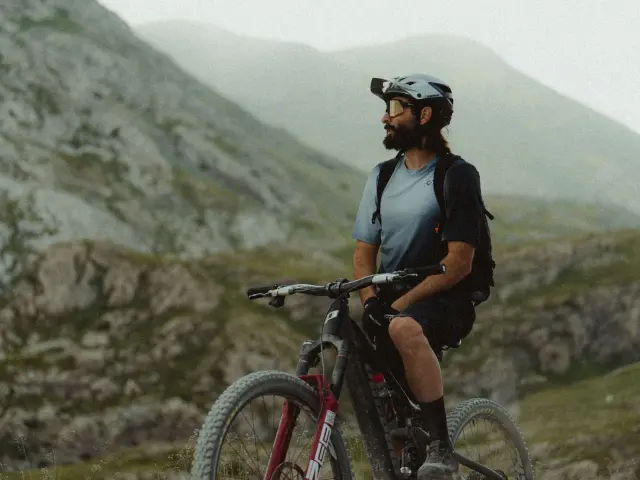
    • Properly fitted helmet (essential).
    • Gloves and goggles.
    • Protective gear depending on practice (knees/elbows, back protector for rough terrain).
    • Lighting if there is a risk of finishing late.
    • First aid kit.
    • Mobile phone
    • Clothing adapted to the weather

    Sharing trails

    Hikers, mountain bikers, trail runners: we all share the same passion for nature. As mountain bikers, we want to share the trails as much as possible:

    • Give priority to walkers
    • Adapt your speed to the visibility
    • Announce your presence courteously or with your horn.
    • Anticipate crossings in narrow areas
    • Dismount if necessary

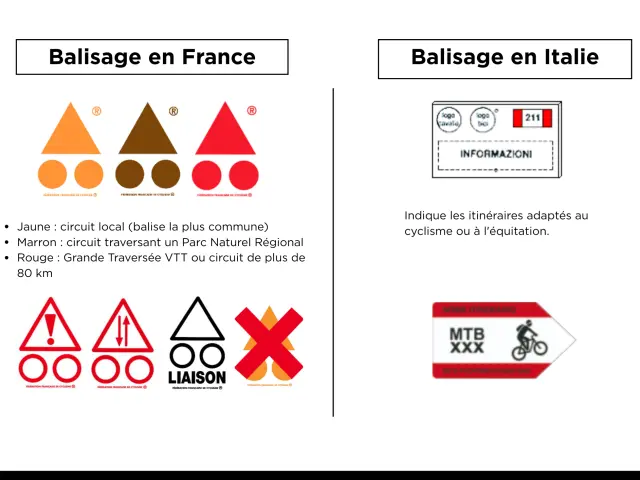
    Mountain bike signs

    As you make your way along the trail, various signs will guide you along the route.

    You’ll find :

    • Signs specific to RivierALP
    • Official signs for France
    • As well as those for Italian territory.

    To find out more and adopt the right reflexes before setting off, you can consult the official recommendations available on the Ministry of Sport website.

    Touring with a VTTAE

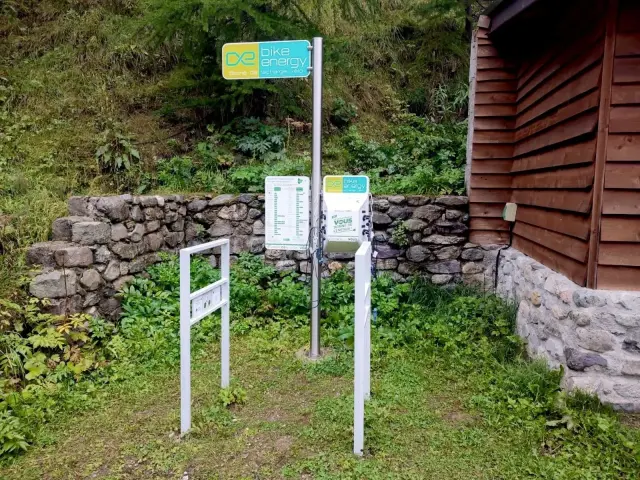
    When you’re touring with a VTTAE, it’s essential to think ahead about where you’re going to recharge your battery. Some recharging points are signposted along the routes, and dedicated terminals are available throughout the region. It is advisable to bring your own adapter so that you can recharge your bike easily. Recharging is also possible in the villages and in some of the refuges along the routes.

    Safety in winter and under the snow

    Winter sports such as ski touring and snowshoeing require specific preparation and compliance with safety rules to deal with the risks associated with snow and winter conditions.

    Avalanche safety

    As well as consulting the weather conditions, in the event of snow cover, the Bulletin d’Estimation du Risque d’Avalanche (BERA) is an essential tool for preparing your outings. Published every day, it details the avalanche risk level for each mountain range for the following day, on a scale from 1 (low) to 5 (very high). The BERA also indicates the most dangerous slopes, their altitude and orientation, as well as the nivological cause of the risk – all essential information to analyse before setting off on your hike.

    The essential avalanche transceiver, probe and shovel kit:

    First of all, never go off on your own, and as soon as you’re on slopes of more than 30°, get yourself a DVA, a probe and a shovel.

    DVA (Détecteur de Victimes d’Avalanche – Avalanche Victims Detector), used to locate people buried under snow thanks to a system of transceivers.
    Probe: used to determine the precise location of a buried person.
    Shovel: used to free the victim.
    It is essential tobe trained to use this equipment correctly and act effectively. In an avalanche, the chances of survival are 90% if the person is freed within the first 10 minutes, then decrease by 3% per minute.